
Gold vs Stock Which is a Best Investment Option
February 27, 2025
Different Types of Silver Grades and How to Identify the Best One
March 27, 2025Gold Assaying Explained How Purity is Tested and Its Impact on Value

Introduction
Have you ever seen how jewellers know exactly how pure your gold is? Or why can that small percentage difference in purity translate to hundreds or even thousands of dollars in value? Today, we're getting deep into the thrilling world of gold assaying—the science and art of determining gold purity that has shaped economies, industries, and personal investments for centuries.
What Is Gold Assaying? Understanding the Basics
Gold assaying is the process of analyzing gold items to determine their purity—the percentage of actual gold content relative to other metals. Think of it as quality control for one of humanity's most treasured metals. When you see markings like 14K, 18K, or 999 on gold jewellery or bullion, these are direct results of assaying tests.
The concept isn't new. Civilizations have been testing gold purity since ancient times, though methods have evolved dramatically from simple scratch tests to today's sophisticated visual analysis. Whether you're purchasing a wedding ring, investing in gold coins, or selling heirloom jewellery, understanding assaying helps you make informed decisions about the true value of your gold.
Why Does Gold Purity Matter? The Relationship Between Purity and Value
"How does gold purity affect its price?" This question captures why assaying exists in the first place. Pure gold (24 karat or 99.9% pure) is soft, malleable, and holds the highest real value by weight. However, this softness makes it impractical for many applications, which is why gold is often alloyed with other metals.
The relationship between purity and value is nearly linear—a 1% increase in purity typically responds to approximately a 1% increase in the metal's base value. However, other factors like craftsmanship, brand, and historical significance can influence final market value beyond pure gold content.
Here's a quick analysis of common gold purities and their approximate relative values:
| Gold Purity | Karat | Percentage | Relative Value (per gram) * |
|---|---|---|---|
| 999 Fine | 24K | 99.9% | 100% of gold spot price |
| 916 Gold | 22K | 91.6% | ~92% of gold spot price |
| 750 Gold | 18K | 75.0% | ~75% of gold spot price |
| 585 Gold | 14K | 58.5% | ~58% of gold spot price |
| 375 Gold | 9K | 37.5% | ~38% of gold spot price |
The Historical Journey: From Old Methods to Modern Technology
Gold assaying has refined remarkably through the hundreds of years:
1. Ancient Methods (3000 BCE onward)
- Touchstone testing: Rubbing gold against a special black stone and comparing the streak's colour
- Fire assaying: Heating gold with lead to separate precious metals from base metals
2. Medieval Developments (500-1500 CE)
- Introduction of formalized hallmarking systems
- Establishment of assay offices in major European cities
3. Industrial Revolution (1750-1900)
- Development of chemical assaying techniques
- Standardization of assaying procedures across countries
4. Modern Era (1900-Present)
- X-ray fluorescence (XRF) technology
- Spectrographic analysis
- Electronic densitometers
Today's most accurate methods can determine gold purity to within 0.001%, a precision that would impress assayers of previous centuries!
How Is Gold Assaying Performed? Common Methods Explained
1. Fire Assaying: The Gold Standard of Testing
Despite being thousands of years old, fire assaying remains the most trusted method for determining gold purity. Here's how it works:
- 1. A sample is taken from the gold item (typically 0.25-0.5 grams)
- 2. The sample is wrapped in lead foil with silver and copper
- 3. This packet is placed in a cupel (a special porous cup) and heated to about 1,650°F (900°C)
- 4. Base metals oxidize and absorb into the cupel, leaving behind precious metals
- 5. The remaining "button" is treated with nitric acid to remove silver and copper
- 6. The pure gold remainder is weighed to calculate the original sample's purity
Fire assaying is destructive but extremely accurate, with precision to within 0.02%. It's primarily used for high-value transactions and official certification.
2. X-Ray Fluorescence (XRF) Analysis: Modern Non-Destructive Testing
XRF analyzers have revolutionized gold testing because they can:
- Provide results in seconds
- Test without damaging the item
- Analyze multiple layers (useful for plated items)
- Identify all metals in an alloy
The analyzer works by soaking the sample with X-rays, causing the particle to emit secondary X-rays at energies characteristic of each element. The machine measures these emissions to determine the exact composition of the alloy.
3. Additional Testing Methods
- Acid Testing: Using test acids of various strengths to observe reactions
- Electronic Testing: Measuring electrical conductivity, which varies by purity
- Ultrasonic Testing: Analyzing sound wave patterns through gold
- Specific Gravity Testing: Measuring density using Mathematician principle
Understanding Gold Purity Labels: Karats, Fineness, and Hallmarks
1. The Karat System
Popular in North America and parts of Europe, the karat system divides pure gold into 24 parts:
- 24K = 100% pure gold (theoretical)
- 18K = 18/24 parts = 75% pure gold
- 14K = 14/24 parts = 58.3% pure gold
- 10K = 10/24 parts = 41.7% pure gold
2. The Minimal Fineness System
Preferred in many international markets, this system expresses purity in parts per thousand:
- 999 = 99.9% pure gold
- 916 = 91.6% pure gold (equivalent to 22K)
- 750 = 75.0% pure gold (equivalent to 18K)
- 585 = 58.5% pure gold (equivalent to 14K)
3. Hallmarking: The Official Certification
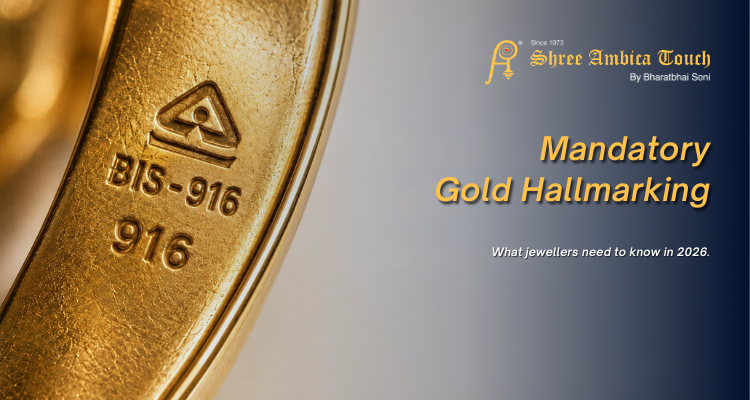
Hallmarks are official stamps applied by assay offices that guarantee a metal's purity. These may include:
- Purity mark (karat or fineness number)
- Assay office mark (identifying where it was tested)
- Maker's mark (identifying the manufacturer)
- Date letter (indicating year of hallmarking)
The Impact of Purity on Gold Value
The relationship between gold purity and value is direct, but not always linear. Market factors, craftsmanship, and historical significance can all influence the final value of your gold items.
Consider this example: A 10-gram 24K gold piece contains 10 grams of pure gold, while a 10-gram 18K piece contains only 7.5 grams of pure gold. At current market rates, this difference could amount to thousands of rupees.
For investors and collectors, understanding this relationship is crucial for making informed decisions about buying, selling, or holding gold assets.
Shree Ambica Touch: Excellence in Gold Assaying
Founded in 1973, Shree Ambica Touch has built a reputation for excellence in gold assaying and all precious metal services. Our commitment to quality and accuracy has made us a trusted name across Gujarat and beyond.
Our updated facility combines traditional expertise with modern technology, guaranteeing the most precise gold purity measurements available. Whether you're buying, selling, or investing in gold, our assaying services provide the certainty you need.
As certified gold importers working with government-trusted mines, we maintain the highest standards of quality and ethical practices in all our operations.
Conclusion
Understanding gold assaying is essential for anyone dealing with precious metals. From the ancient touchstone method to innovative XRF analysis, these techniques ensure that you know exactly what you're buying or selling.
At Shree Ambica Touch, we're committed to transparency and accuracy in all our gold assaying services. Whether you're an investor, collector, or simply looking to sell unwanted jewellery, our expert team is here to help you determine the true value of your gold.
Contact us today and experience the difference that five decades of expertise can make in your gold transactions. Because when it comes to gold, purity isn't just a number—it's the foundation of value.