
Gold Import Duty in India 2026: What Jewellers,Investors and Bullion Buyers Should Know
June 10, 2026
Why Silver Prices Are More Volatile Than Gold: Understanding the Market Dynamics
July 4, 2026Gold Recycling in India: Why Old Gold Refining Is the Smarter Way Forward

Introduction
Gold has always held a special place in India's economy, culture, and investment landscape. From family heirlooms and wedding jewellery to investment bars and coins, the yellow metal has remained one of the country's most trusted stores of wealth for generations.
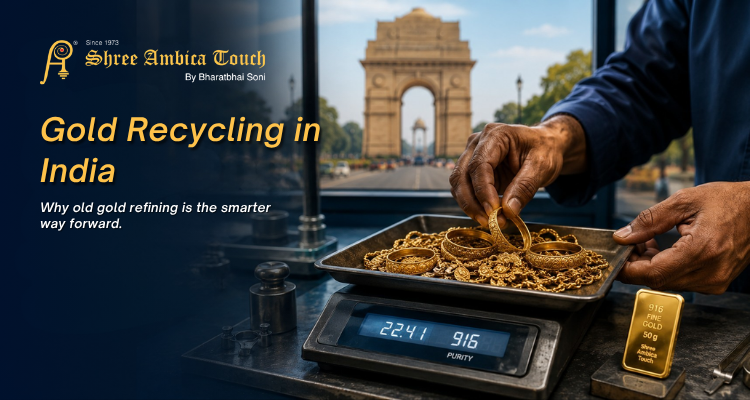
However, as gold prices continue to trade at historically high levels and sustainability becomes a global priority, a new trend is reshaping the Indian bullion industry gold recycling.
Instead of relying solely on imported gold, India is increasingly recovering valuable precious metal from old jewellery, coins, manufacturing scrap, and industrial waste. Gold recycling has emerged as an efficient, environmentally responsible, and economically beneficial solution for both consumers and the bullion industry.
Today, refining old gold is no longer just about melting unwanted jewellery. It involves advanced purification technologies, internationally accepted refining standards, and certified purity testing that transform old gold into high-quality bullion ready for investment or manufacturing.
In this blog, we explore why gold recycling is becoming increasingly important in India, how the refining process works, the benefits it offers, and why it represents the future of responsible bullion management.
India's Growing Gold Demand and Supply Challenge
India is consistently among the world's largest consumers of gold. Every year, demand is driven by jewellery purchases, festivals, weddings, investment products, and industrial applications.
Despite this massive demand, domestic gold mining contributes only a very small percentage of India's annual requirement. The country depends heavily on imports, making gold prices sensitive to global market fluctuations, exchange rates, and import duties.
This has significantly increased the importance of recycled gold as an alternative source of supply.
India's Gold Supply Overview
| Source of Gold | Approximate Share |
|---|---|
| Imported Gold | 70–80% |
| Recycled Gold | 18–25% |
| Domestic Mining | Less than 2% |
Source: World Gold Council (WGC), India Bullion & Jewellers Association (IBJA), Metals Focus.
As gold prices remain elevated, more households and jewellers are choosing to recycle existing gold instead of purchasing newly mined bullion.
Why Gold Recycling Is Growing Rapidly in India
Several economic and industry factors are accelerating the growth of gold recycling.
1. Record Gold Prices
With gold reaching record highs over the past two years, unused jewellery has become a valuable financial asset rather than simply an ornament stored away.
Many families are choosing to:
- Convert old jewellery into new designs
- Refine inherited ornaments into pure bullion
- Liquidate idle gold when needed
- Upgrade old jewellery while retaining value
Higher prices naturally encourage consumers to recover maximum value from existing gold holdings.
2. Lower Dependence on Imports
India imports hundreds of tonnes of gold annually.
Every kilogram of recycled gold reduces dependence on imported bullion, helping:
- Improve domestic supply
- Reduce pressure on foreign exchange reserves
- Strengthen the Indian bullion ecosystem
- Support a more sustainable circular economy
3. Environmental Sustainability
Gold mining is one of the most resource-intensive industries in the world.
Mining new gold requires:
- Large-scale excavation
- Significant water consumption
- High energy usage
- Extensive land disturbance
Gold recycling dramatically reduces this environmental footprint.
Environmental Comparison
| Category | Newly Mined Gold | Recycled Gold |
|---|---|---|
| Mining Required | Yes | No |
| Energy Consumption | High | Significantly Lower |
| Water Usage | Very High | Minimal |
| Carbon Emissions | High | Up to 90–95% Lower |
According to the World Gold Council, recycled gold can significantly reduce greenhouse gas emissions compared to newly mined gold.
Understanding the Gold Refining Process
Modern gold refining is a highly scientific process that removes impurities while preserving maximum precious metal recovery.
The typical refining journey includes:
Step 1 – Collection & Assessment
Old jewellery, coins, manufacturing scrap, or industrial gold is carefully evaluated.
Step 2 – Purity Testing
Advanced analytical techniques such as:
- Fire Assay
- X-Ray Fluorescence (XRF)
- Spectrometric Analysis
are used to determine the exact purity.
Step 3 – Melting
The material is melted under controlled temperatures.
Step 4 – Refining
Impurities like copper, silver, nickel, and zinc are removed through specialized refining techniques.
Step 5 – Final Certification
The purified gold is tested again before being converted into:
- Bullion bars
- Investment coins
- Jewellery manufacturing material
- Industrial-grade gold
Where Does Recycled Gold Come From?
Gold recycling extends beyond old jewellery.
Major Sources of Recycled Gold
| Source | Industry Contribution |
|---|---|
| Old Jewellery | Highest |
| Jewellery Manufacturing Scrap | High |
| Investment Bars & Coins | Moderate |
| Electronic Components | Growing |
| Industrial Scrap | Moderate |
The increasing recovery of gold from electronic waste is expected to become a major contributor in the coming years.
Benefits of Gold Recycling
For Consumers
- Unlock value from unused jewellery
- Obtain certified purity
- Upgrade designs without purchasing entirely new gold
- Preserve long-term investment value
For Jewellers
- Reliable supply of refined raw material
- Better inventory management
- Reduced procurement costs
- Responsible sourcing practices
For the Bullion Industry
- Reduced import dependence
- Improved domestic gold circulation
- Stronger sustainability credentials
- Greater supply chain efficiency
Why Certified Refining Matters
Choosing a professional refinery is essential for ensuring transparency and purity.
A trusted refinery provides:
- Accurate purity analysis
- Transparent recovery calculations
- International refining standards
- Advanced laboratory testing
- Secure handling
- Certified bullion production
This builds confidence for both individual customers and businesses.
Gold Recycling and India's Circular Economy
Gold is one of the few materials that can be recycled repeatedly without losing its intrinsic quality or value.
Unlike many industrial metals, refined gold retains:
- Purity
- Market value
- Investment appeal
- International acceptance
This makes gold recycling a perfect example of a circular economy—where valuable resources continue to be reused rather than discarded.
Industry Outlook: What Experts Are Saying
Leading industry organizations, including the World Gold Council, Metals Focus, and the London Bullion Market Association (LBMA), believe recycled gold will continue to play an increasingly important role in the global bullion market.
Key reasons include:
- Rising gold prices
- Greater environmental awareness
- Responsible sourcing initiatives
- Limited new mining output
- Growing demand for sustainable bullion
As sustainability becomes a key priority across industries, recycled gold is expected to account for an even larger share of future gold supply.
Why Choose Shree Ambica Touch?
For over five decades, Shree Ambica Touch has been committed to excellence in gold refining, assaying, and bullion manufacturing.
Our expertise combines:
- Advanced refining technology
- Accurate purity testing
- Transparent refining practices
- International quality standards
- Trusted service since 1973
Whether serving individual customers, jewellers, or institutional clients, our commitment remains the same—delivering precision, purity, and trust.
Frequently Asked Questions
Conclusion
India's relationship with gold is evolving. While imports will continue to play an important role, recycled gold is emerging as one of the country's most valuable and sustainable sources of precious metal.
By refining unused jewellery into certified, high-purity bullion, gold recycling not only supports environmental responsibility but also strengthens India's bullion ecosystem, reduces reliance on imports, and unlocks dormant wealth.
As demand for responsible sourcing and certified precious metals continues to grow, gold recycling is no longer simply an alternative it is becoming the smarter way forward.
Sources & References
This article is based on publicly available information and industry insights from:
- World Gold Council (WGC)
- India Bullion & Jewellers Association (IBJA)
- London Bullion Market Association (LBMA)
- Metals Focus
- Reserve Bank of India (RBI)
- Ministry of Commerce & Industry, Government of India
DisclaimerThe data and statistics presented in this article are based on publicly available industry reports and may vary over time due to changing market conditions. This blog is intended solely for informational purposes and should not be interpreted as financial, investment, or legal advice.