
A Journey of Faith, Family and Precious Metals: India’s Festive Season from July to December
July 22, 2026
When Gold Prices Rise, Every Gram Matters More: What Changing Jewellery Demand Means for Jewellers in 2026
August 19, 2026Mandatory Gold Hallmarking in India 2026: BIS District Expansion and Compliance Guide forJewellers

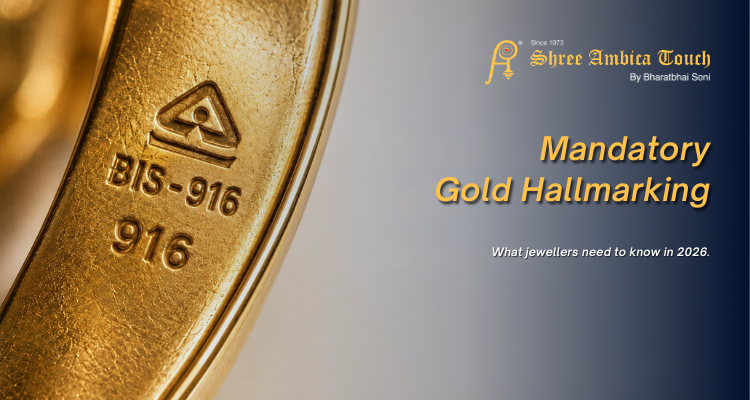
A BIS 916 hallmark is more than just a stamp—it is your assurance of certified gold purity, authenticity, and trust. Learn why mandatory gold hallmarking is essential for every gold buyer in India.
Lorem ipsum dolor sit amet, consectetur adipiscing elit, sed do eiusmod tempor incididunt ut labore et dolore magna aliqua. Ut enim ad minim veniam, quis nostrud exercitation ullamco laboris nisi ut aliquip ex ea commodo consequat. Duis aute irure dolor in reprehenderit in voluptate velit esse cillum dolore eu fugiat nulla pariatur. Excepteur sint occaecat cupidatat non proident, sunt in culpa qui officia deserunt mollit anim id est laborum.
Introduction
In the jewellery industry, trust begins with what a customer can see, but it is sustained by what can be measured and
verified. A gold ornament may appear flawless in design and finish, yet its true value depends on measurable factors
such as purity, fineness, weight and authenticity.
India’s mandatory hallmarking framework continued to expand in 2026. The Hallmarking of Gold Jewellery and Gold
Artefacts (Amendment) Order, 2026 came into force on 2 March 2026. Under the sixth phase, seven additional districts
were brought within the framework, increasing the number of covered districts from 373 to 380 at that stage.
A later Second Amendment dated 28 April 2026 replaced the official district annexure. The BIS-published amendment
identifies an updated annexure covering 385 districts. Jewellers should therefore verify their location against the latest
official list rather than relying only on the March sixth-phase announcement.
The key distinction
The sixth phase added seven districts and took the total to 380 in March 2026. A subsequent amendment replaced the
annexure, with the updated BIS document covering 385 districts.
What changed under the sixth phase?
The sixth phase of mandatory hallmarking expanded coverage by adding seven new districts, while a subsequent BIS amendment updated the official annexure to cover 385 districts.
Businesses should always rely on the latest BIS notification instead of older announcements.
The seven districts added under the sixth phase were:
Districts Added Under the Sixth Phase
| State | Newly Added District |
|---|---|
| Punjab | Rupnagar |
| Uttar Pradesh | Banda |
| Maharashtra | Beed |
| Tripura | Gomati |
| Bihar | Katihar |
| Rajasthan | Beawar |
| Madhya Pradesh |
Neemuch |
These additions continue the Government's effort to expand standardized purity verification across India's jewellery market.
Growth of Mandatory Hallmarking in India
| Phase | Effective Date | Districts Added | Total Covered |
|---|---|---|---|
| First | 23 June 2021 | 256 | 256 |
| Second | 4 April 2022 | 32 | 288 |
| Third | 8 September 2023 | 55 | 343 |
| Fourth | 5 November 2024 | 18 | 361 |
| Fifth | 31 July 2025 | 12 | 373 |
| Sixth | 2 March 2026 | 7 |
380 |
District coverage may continue to evolve through future amendments. Jewellers should always refer to the latest BIS annexure.
What is BIS Hallmarking?
According to the Bureau of Indian Standards (BIS), hallmarking is the official determination and recording of the precious metal content in jewellery and artefacts.
Rather than simply stamping jewellery, the hallmark represents an entire process involving:
- Article recording
- Purity declaration
- Examination
- Assaying
- Conformity assessment
- Laser marking
- HUID-based traceability
Typical hallmarking workflow includes:
- Receipt of jewellery
- Weighment
- Preliminary examination
- Fire assay
- Purity verification
- Laser marking
- HUID assignment
Understanding HUID (Hallmark Unique Identification)
Since 1 July 2021, every hallmarked gold jewellery article carries a six-digit alphanumeric HUID.
Every hallmarked article should display:
- BIS Standard Mark
- Purity (Carat & Fineness)
- Six-digit HUID
Consumers can verify the authenticity of a HUID through the BIS CARE App, improving transparency and article-level traceability. A simple "916" stamp alone is not sufficient evidence of current BIS hallmarking.
Gold Purity Grades Covered
Mandatory hallmarking currently covers:
- 14K
- 18K
- 20K
- 22K
- 23K
- 24KS
The Indian Standard also includes 9K as a voluntary hallmarking grade. The declared purity submitted for hallmarking must accurately match the article's fineness to avoid rejection or delays.
Who Needs BIS Registration?
Manufacturers, wholesalers, distributors, and retailers selling hallmarked gold or silver jewellery must obtain BIS registration.
Important points:
- BIS registration is issued online.
- No registration fee is charged.
- Registration remains valid for a lifetime.
- Jewellers with an annual turnover of up to ₹40 lakh are exempt from mandatory hallmarking, though those selling hallmarked articles must still comply with registration requirements.
First Point of Sale Responsibility
Responsibility for hallmarking generally applies at the first point of sale, where:
- Ownership transfers
- A tax invoice is generated
- Physical delivery takes place
Proper documentation among manufacturers, wholesalers, distributors, and retailers is essential to maintain compliance.
What About Old Jewellery Without HUID?
Older jewellery carrying traditional hallmarks but lacking a six-digit HUID should not automatically be treated as compliant for sale.
Jewellers may:
- Re-hallmark existing jewellery after assaying.
- Melt and remanufacture the jewellery before obtaining a new HUID.
Managing legacy inventory has therefore become an important compliance exercise.
Invoice Requirements
BIS recommends invoices for hallmarked jewellery include:
- Description of the article
- Net precious metal weight
- Purity (Carat & Fineness)
- Hallmarking charges
Invoices should also inform customers that purity verification can be carried out at BIS-recognized Assaying and Hallmarking Centres.
How the Hallmarking Process Works
The hallmarking process generally follows six stages:
- Submission of jewellery by the registered jeweller
- Receipt and weighment
- Preliminary examination
- Fire assay and sampling
- Acceptance or rejection based on purity
- Laser marking and HUID assignment
Fire assay remains the recognized method under IS 1418 for determining gold purity.
What Jewellers Should Do in Newly Covered Districts
Businesses should:
- Verify district coverage.
- Confirm BIS registration.
- Audit inventory.
- Identify recognized Assaying and Hallmarking Centres.
- Strengthen purity testing before submission.
- Review invoicing procedures.
- Train sales and operational teams on HUID verification and compliance responsibilities.
Key Exemptions
The BIS framework provides exemptions for certain categories, including:
- Articles weighing less than 2 grams
- Export jewellery
- Medical, scientific, veterinary, and industrial articles
- Gold thread
- Incomplete articles under manufacture
- Certain bullion forms
- Jewellery for exhibitions
- Kundan, Polki, and Jadaau jewellery
- Gold watches and fountain pens
- Jewellers with annual turnover up to ₹40 lakh
Eligibility depends on the latest BIS regulations and applicable conditions.
Why Mandatory Hallmarking Matters
The expanded hallmarking system offers benefits across the jewellery ecosystem:
- Higher consumer confidence
- Better supply chain accountability
- Consistent quality standards
- Reduced purity disputes
- Improved traceability through HUID
- Stronger brand credibility
- Greater trust in precious metal transactions
Why Accurate Assaying Remains Critical
Hallmarking is only as reliable as the testing process behind it.
Incorrect purity declarations can lead to:
- Rejection during hallmarking
- Inventory delays
- Increased refining costs
- Production disruptions
- Customer dissatisfaction
- Supplier disputes
Professional assaying should therefore be integrated throughout procurement, refining, manufacturing, exchange, and final quality control not treated as a final step.
How Shree Ambica Touch Supports Jewellers
As hallmarking regulations continue to evolve, Shree Ambica Touch provides technical support through:
- Gold and silver assaying
- Precious metal purity testing
- Hallmarking-related support
- Old gold evaluation
- Precious metal refining
- Transparent technical reporting
These services help jewellers maintain compliance while improving operational efficiency and customer trust.
Conclusion
Mandatory Gold Hallmarking in India is no longer simply a regulatory requirement it has become a cornerstone of trust, transparency, and quality assurance within the jewellery industry. As BIS expands hallmarking coverage across more districts, jewellers who adopt robust purity verification, accurate assaying, and disciplined documentation will be better positioned to strengthen customer confidence and ensure long-term business success.
Ultimately, every hallmark should represent not only compliance but also the integrity of the processes behind it. For businesses seeking dependable purity testing, refining, and hallmarking-related support, Shree Ambica Touch remains committed to delivering technical accuracy and trusted precious metal services.