

Why Central Banks Are Increasing Their Gold Reserves in 2026: Global Conflicts and Economic Uncertainty
March 25, 2026
Is 2026 the Right Time to Invest in Silver? Market Trends, Demand & Future Outlook
April 24, 2026Why Gold and Stock Markets Are Falling Together in 2026 – A Rare Market Shift Explained

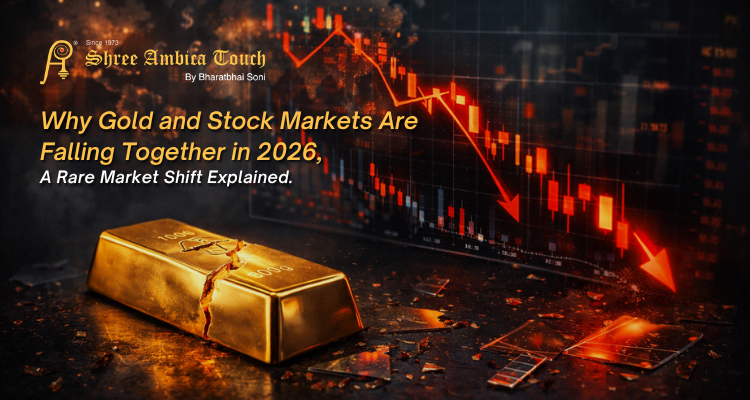
When traditional market patterns break, it signals a deeper global shift. 2026 is not just about falling prices, it is about changing financial behavior.
Introduction
For decades, investors have relied on a simple principle: when stock markets fall, gold rises. This inverse relationship has been considered a foundational rule of investing.
However, 2026 is challenging that belief.
Stock markets are under pressure. Global uncertainty is rising. Yet gold is not performing as a traditional safe-haven asset in the short term.
This unusual alignment is not accidental. It reflects deeper structural changes in global financial dynamics.
Why Is Gold Not Rising in 2026?
The current scenario has left many investors questioning gold’s role. Traditionally, gold attracts demand during uncertainty, but today both equities and gold are experiencing downward pressure simultaneously.
This shift is driven by a combination of macroeconomic forces rather than a breakdown of gold’s fundamental value.
1. Strength of the US Dollar
The dominance of the US dollar in global trade continues to influence asset performance.
Most international transactions, including oil, defence, and commodities, are denominated in dollars. When the dollar strengthens:
- Importing nations require more local currency
- Investors shift preference towards dollar holdings
- Gold becomes relatively expensive for global buyers
This reduces immediate demand for gold and creates price pressure.
2. Global Liquidity Pressure
A key driver of the current market behaviour is the need for liquidity.
Rising energy costs, geopolitical tensions, and increasing import expenses have created a situation where governments and institutions require immediate access to cash.
Instead of holding long-term assets like gold:
- Some institutions are liquidating gold reserves
- Others are reallocating funds into cash or dollar-based assets
This temporary shift increases selling pressure across asset classes, including gold.
3. Central Bank Portfolio Adjustments
Over the past few years, central banks have been consistent buyers of gold. However, short-term economic pressures can lead to strategic adjustments.
During tightening cycles:
- Gold may be used to meet liquidity requirements
- Portfolio rebalancing can lead to temporary sell-offs
This contributes to a rare phase where both equities and gold decline simultaneously.
4. Gold Is a Long-Term Asset, Not a Short-Term Reaction Tool
A common misconception is expecting gold to react instantly to market uncertainty.
Unlike equities or high-volatility assets, gold operates differently:
- It responds to long-term macroeconomic trends
- It reflects currency stability and inflation over time
- It acts as a wealth preservation tool rather than a trading instrument
Short-term fluctuations are influenced by interest rates, currency strength, and liquidity needs, but they do not alter gold’s long-term relevance.
Market Dynamics Comparison (2026 Scenario)
| Factor | Impact on Gold | Impact on Stock Market |
|---|---|---|
| Strong US Dollar | Negative pressure due to high pricing | Negative for global earnings |
| Liquidity Demand | Selling pressure from institutions | Market sell-offs for cash needs |
| Rising Interest Rates | Reduces gold attractiveness | Increases borrowing costs |
| Geopolitical Tensions | Long-term positive | Short-term negative volatility |
| Central Bank Actions | Short-term selling possible | Market uncertainty |
Understanding Asset Roles in a Portfolio
Instead of focusing on short-term price movements, it is important to understand the role each asset plays.
| Asset Type | Primary Purpose | Behaviour in Uncertainty |
|---|---|---|
| Stocks | Growth | High volatility |
| Cash | Liquidity | Stability |
| Gold | Wealth preservation | Long-term stability |
This perspective clarifies why gold may not always rise immediately during crises, but remains essential for long-term balance.
What This Means for Investors
The current market is not contradicting traditional investment principles. Instead, it is highlighting how interconnected global systems have become.
Gold and stocks falling together is uncommon, but it reflects:
- Currency dominance influencing asset flows
- Immediate liquidity needs overriding long-term positioning
- Short-term adjustments within broader economic cycles
For investors, this reinforces the importance of diversification and clarity of asset purpose.
Conclusion
The events of 2026 demonstrate that financial markets are evolving.
Gold’s temporary underperformance alongside equities does not weaken its position. It continues to represent stability, trust, and long-term value preservation.
Understanding the broader economic environment is essential to interpreting such rare market movements.
Shree Ambica Touch, Your Trust in Purity
In a market where prices fluctuate, one element must remain constant: purity and trust.
Shree Ambica Touch has built its legacy since 1973 by ensuring accuracy, transparency, and reliability in precious metals.
Whether you are investing or evaluating, the foundation of every decision should be backed by certified purity and trusted expertise.